
California’s 2026 Building Code: New Insulation, Heat Pump and Wildfire Rules for Remodels
R-38 attic insulation now reaches the San Fernando Valley and coastal LA, heat pumps are the new baseline, wildfire rules have their own code, and Zone 0 is coming. Here’s what it means for your project.
Get a free estimate
Name, phone and ZIP — Mike calls or texts you back within 9 minutes.
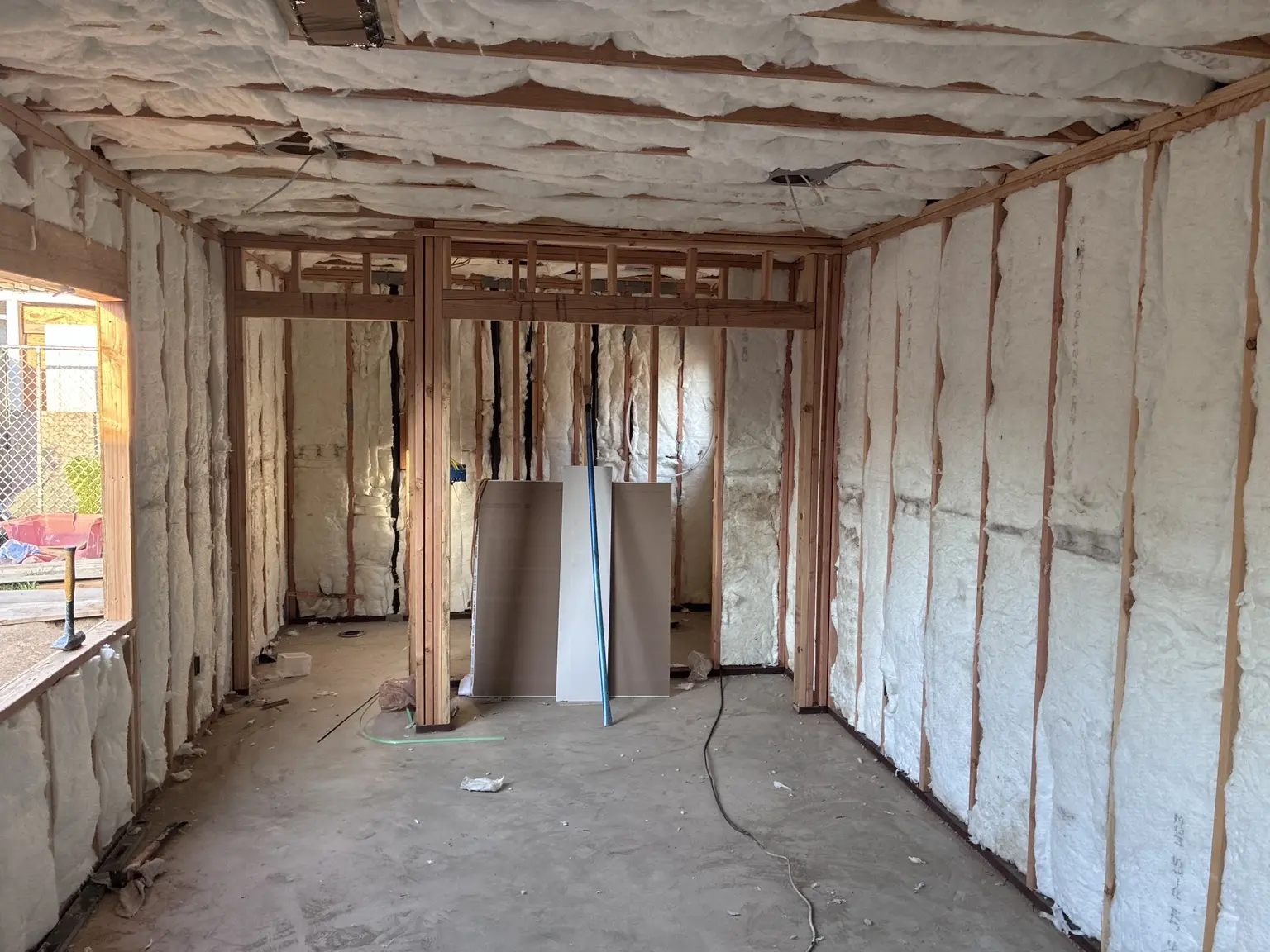
Every three years California updates its building codes. The newest set — the 2025 California Building Standards Code, Title 24 — applies to permit applications submitted on or after January 1, 2026. If you are planning a kitchen or bathroom remodel, an addition or an ADU in Los Angeles this year, these are the changes most likely to show up in your plans and your price.
1. More attic insulation in the Valley and the LA basin
Under the 2025 Energy Code, the prescriptive attic insulation for vented attics is R-38 in climate zones 1 and 8–16. Zones 8, 9 and 10 were newly added — and that is most of Los Angeles: zone 9 covers the San Fernando Valley and much of the LA basin, zone 8 the inland areas nearer the coast, zone 10 the inland valleys to the east. Before, those zones used R-30. Cathedral (vaulted) ceilings call for R-38 in all climate zones.
Walls keep the mandatory minimums: R-15 in 2x4 framing and R-21 in 2x6 framing (or the equivalent U-factor).
- New addition or ADU: plan for R-38 in a vented attic in zones 8–10, unless your energy consultant shows compliance another way.
- Remodel that opens the attic or ceiling: it is usually the cheapest moment to bring insulation up to current levels, even when the code does not require it.
- Vaulted ceilings: R-38 needs deeper rafters or rigid insulation — this affects framing and should be decided at the design stage.
2. Heat pumps are the new baseline
For new single-family homes the prescriptive path now assumes a heat pump for space heating in every climate zone. Gas heating is still possible, but only through the performance path — an energy model showing the house makes up for it elsewhere. For additions, the prescriptive gas water-heating option was removed, and new HVAC load-calculation and equipment-capacity limits apply.
Heat pumps also get new verification: refrigerant charge checks by a certified rater, defrost and supplemental-heat controls, and equipment sized by ACCA load calculations. When an existing air conditioner or heat pump is replaced in an alteration, airflow and refrigerant-charge verification apply in most of Los Angeles’ climate zones.
3. Ducts inside the conditioned space
The prescriptive path wants ducts and the air handler entirely inside the conditioned space, verified by a rater — or, if the attic is not a high-performance attic, ducts installed below the ceiling. In practice that means designing soffits or chases for ducts early, instead of running them through a hot attic.
4. Battery-ready new homes and bigger electrical planning
New single-family homes with electrical service over 125 amps must be battery-storage ready. Where a gas water heater is installed, an electric-ready 30-amp branch circuit is required so it can be swapped for a heat pump water heater later. Heat pump water heaters also need enough air around them — at least 100 cubic feet per kBtu/h of capacity, or the manufacturer’s requirement if larger.
5. Wildfire rules now have their own code: Part 7
The 2025 code adds Part 7, the California Wildland-Urban Interface Code. It gathers the wildfire construction requirements — ignition-resistant roofs, vents, siding, decks, windows and similar details — into one consistent set of rules instead of a chapter inside the building code. If your property is in a mapped Fire Hazard Severity Zone (parts of Sylmar, Tujunga, Sunland, Granada Hills, Porter Ranch, Encino, Woodland Hills and the hillside areas of Burbank, Glendale and Pasadena are), expect your plans to be checked against Part 7.
6. Zone 0: the first five feet around the house
On August 19, 2026, the State Board of Forestry and Fire Protection adopted emergency “Zone 0” regulations: an ember-resistant zone within five feet of a home. They take effect only after the Office of Administrative Law approves and files them, and they phase in:
- Where it applies: throughout State Responsibility Areas, and in local areas (like the City of Los Angeles) only in Very High Fire Hazard Severity Zones.
- What it asks: no combustible mulch, bark or wood chips, no firewood, clean roofs and gutters, and no combustible fences or gates attached to the house — a 5-foot noncombustible span instead.
- New homes: rules start after the Board posts its updated guidance (up to one year after adoption).
- Existing homes: basic maintenance applies right away once effective; the rest phases in over three to five years.
For a remodel or addition in a Very High zone, this matters for what we build next to the house: a wood fence tied into the wall, a wood deck or pergola, or landscaping beds against the foundation. Planning them as noncombustible now avoids tearing them out later.
What this means for your project
- Permits applied for on or after January 1, 2026 follow the new code, even for projects designed earlier.
- Budget for an energy compliance report (Title 24) on additions and ADUs — it decides insulation, windows and HVAC.
- Ask early whether your lot is in a Fire Hazard Severity Zone; it changes roofing, vents, siding and what can go within five feet of the walls.
- When walls or ceilings are open anyway, upgrading insulation and moving ducts inside costs far less than doing it later.
BFF Construction and Design (CSLB #1109001) designs and builds remodels, additions and ADUs in Los Angeles County. We prepare the Title 24 energy report, the drawings and the permit package as part of the project, so the new rules are handled before construction starts.
Frequently asked questions
When did the new California building code take effect?
The 2025 California Building Standards Code applies to permit applications submitted on or after January 1, 2026. Some cities adopt local amendments, so check with your building department.
How much attic insulation do I need in Los Angeles now?
For vented attics, the 2025 Energy Code’s prescriptive requirement is R-38 in climate zones 1 and 8–16, which now includes zones 8, 9 and 10 covering most of Los Angeles. Projects can also comply through an energy model.
Do I have to install a heat pump?
Not necessarily. Heat pumps are the prescriptive baseline for new homes, but gas equipment can still be used through the performance path if the energy model shows compliance.
Is Zone 0 already in effect?
Not yet. The August 2026 package was withdrawn from OAL review on September 8, and the Board re-adopted revised rules on November 5, 2026 — see our Zone 0 update guide. Many requirements phase in over several years. Check the current status with your fire department.
Is this legal advice?
No. This is a summary of public sources. Requirements depend on your address and the permit date — confirm with your building department or a qualified professional.
Related
- California Energy Commission — 2025 Energy Code overview
- CALBO — 2025 California Energy Code: what changed for single-family
- Town of Paradise — 2025 Energy Code significant changes (slides)
- Placer County — 2025 California Building Standards Code begins Jan. 1
- BB&K — Board of Forestry adopts emergency Zone 0 regulations

 Not approved with HFS, or want to compare?